Wave for Mac, Windows & Linux
Record everything you hear and say with the Wave desktop app on Mac, Windows, or Linux — with no bot joining your calls and no limit on recording length.
The Wave AI desktop app records everything you hear and say on your computer — your microphone plus the audio playing through your speakers — then transcribes and summarizes it automatically. It's how you record a Zoom, Google Meet, or Teams call without a bot joining, and there's no limit on how long a recording can run.
Install and sign in
Download it at app.wave.co/desktop/download. It runs on macOS 12+, Windows 10+, and Linux (beta: x64 or ARM64, as an AppImage or DEB).
Open the downloaded disk image and drag the Wave icon into your Applications folder. Launch it from the disk image or your Downloads folder instead and Wave asks "Move Wave AI to the Applications folder?" — click Move to Applications, because automatic updates can't install from anywhere else.
Prefer the command line? Install with Homebrew: brew install --cask mohrer-associates/tap/wave-ai. It puts Wave in your Applications folder, and Wave keeps itself updated from there.
Then click Sign in with Wave. Your browser opens the normal Wave login and hands you back to the app — there's no separate desktop password. Use the same account as your phone and everything you've already recorded is there. See using Wave on multiple devices.
Record
Wave records every enabled source at once — one or more microphones plus System Audio — and mixes them into a single recording. If nothing is arriving, the header reads No input detected — check audio sources. Switching sources on and off, and the permissions macOS asks for, are covered in desktop audio setup.
Cancel recording throws the audio away, and asks first: "Are you sure you want to cancel the recording? All recorded audio will be lost."
While you record, you can also:
- Type into Take notes while you record… — notes save as you go and land in the session's Notes tab. See taking notes during a recording.
- Click Screenshot for a full-screen grab, or open its menu and choose Capture area to drag out a region. Shots attach to the session's Photos tab. See adding photos to your recordings.
- If a calendar event is running, Wave shows it with Use calendar name and a Guests for email follow-up list — check attendees to email them the summary when you stop. See Wave guests.
Closing Wave, the tray, and the mini window
The close button never ends a recording. While you're recording, closing the main window hides it and opens the mini window so you keep the stop controls. On a Mac, closing the window hides Wave to the menu bar. On Windows and Linux, Wave asks "Do you want to keep Wave running in the background?" — choose Keep running in background or Quit Wave, and tick Remember my choice to skip the question next time. On Mac and Windows, the first time Wave hides you get a "Wave is still running" notice.
Use the Wave icon there to bring the window back. Its menu has Start Recording (or Stop Recording while one is running), Open Wave, Open Mini Window, your version number, and Quit. On Windows and Linux it also has Quit Wave when window closes, which changes the remembered close choice. Quit mid-recording and Wave asks first: "Wave is still recording." with Stop recording & quit Wave or Cancel.
For a smaller footprint, open your avatar menu and choose Mini window (or Open Mini Window from the tray menu) — an always-on-top controller you can drag anywhere, with the timer, the status (Ready, Recording, Paused, No input), start and stop, Cancel recording, Take screenshot, Capture area, and Expand to main window. Close the main window mid-recording and it appears on its own.
Launch at login
Turn on Start Wave automatically when you log in to your computer in Settings → General → Startup, and Wave starts in the background, ready for your next meeting. On Linux this adds a desktop autostart entry; for an AppImage it points at the file's current location.
Meeting prompts and reminders
With a calendar connected, a meeting prompt floats up about two minutes before each event, showing the event title (or Upcoming Meeting) and its time, or Starting now once it begins. When the event has a video link, the main button reads Join plus the app name (for example Join Zoom), or Join meeting, with "& record with Wave" underneath — it opens the link and starts recording on this computer. The arrow beside it offers Join without recording and Record without joining. With no link, the button reads Record and the arrow offers Open Wave. Close it with the X or Dismiss, or leave it: it clears itself after two minutes and appears once per event. Turn it off with Remind me before calendar meetings start in Settings → General → Notifications & reminders.
The calendar connection is what gives your recordings their meeting title, attendees, and time — see connect your calendar.
Wave also nudges you when another app is using your microphone and Wave isn't recording (Mac and Windows only), and when a recording goes quiet for a couple of minutes. Both live in Settings → General → Notifications & reminders.
Your library
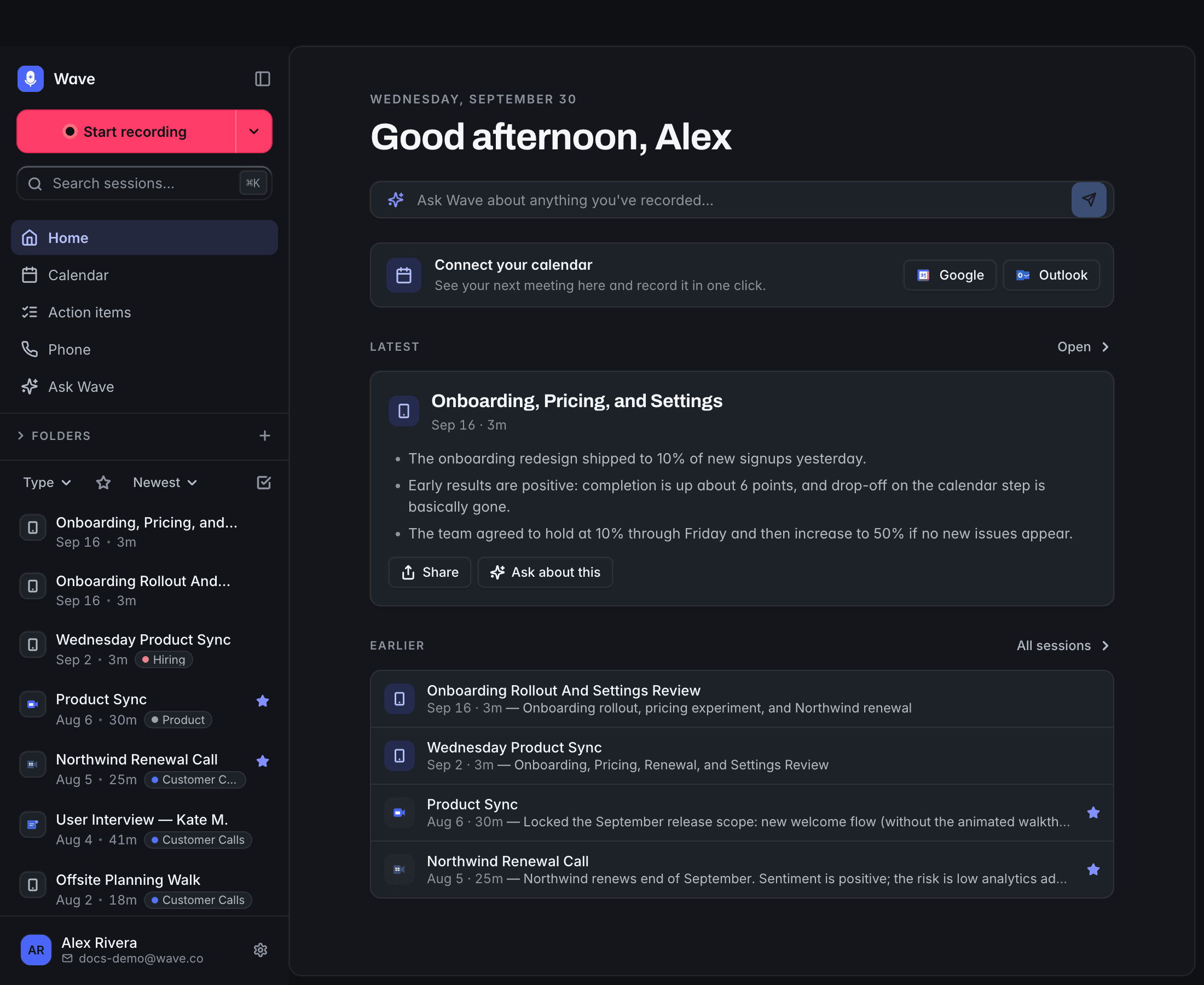
The sidebar holds Home, All sessions, Calendar, Action items, Phone, People, Ask Wave, Podcasts, your Folders, and every session you've recorded on any device. Type in Search sessions... to filter the list, sort by Newest first, Oldest first, or Title, and use the filter menu above the list (it shows the current view, All by default) to pick All, Unsorted, or Favorites (plus Shared with me once someone has shared a session with you), a Source such as Recordings, Meeting bot, Phone calls, Imports, YouTube, or Podcasts, or Recently Deleted at the bottom. Each source shows how many sessions it holds. The star shows favorites only, and the checkbox icon (Select sessions) lets you act on several at once. Press ⌘K (Ctrl+K on Windows and Linux) to open the command palette and jump to any session, folder, or action.
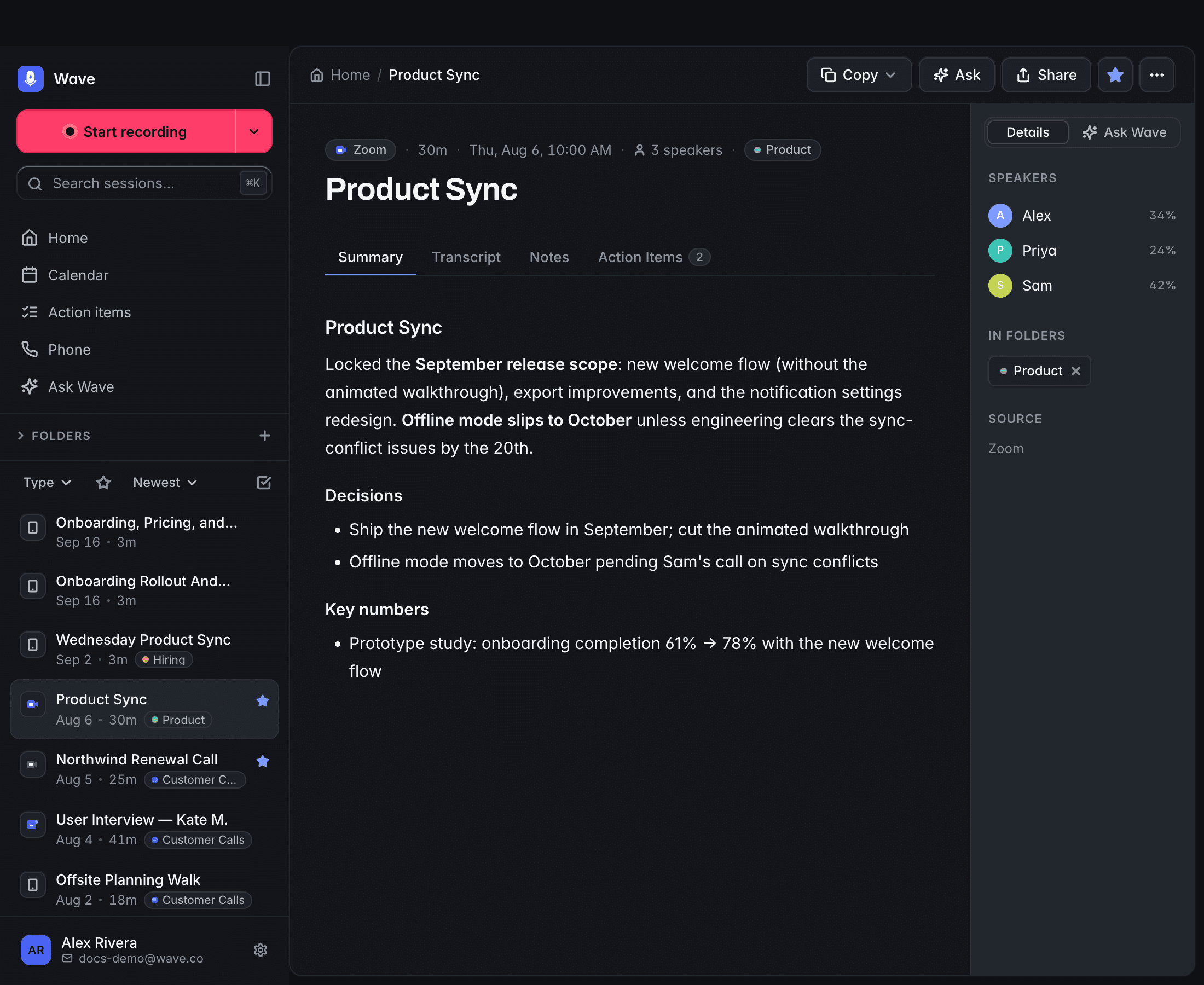
Right-click a session for Open, Add to favorites, Folders, Rename, Share…, Copy public link (once it's shared publicly), or Delete. Inside a session, the ⋯ menu adds Open on Web (opens it at app.wave.co, already signed in), Customize summary, Continue recording, Trim recording, Download audio, and Delete audio…, which removes the recording's audio but keeps the transcript and summary.
Settings and updates
Settings tabs include Account, General, Audio, Transcription, Notes & titles, Integrations, Privacy & data, Recovery, and About. Recovery is where an interrupted recording reappears so you can upload it — see file recovery.
Wave keeps itself current: it checks at launch and every two hours and downloads in the background. When an update is ready it says "Wave is ready to update to version …" with Restart Wave Now or Later — Later installs it the next time Wave quits. It never asks in the middle of a recording, and if Wave has been sitting hidden in the tray for about ten minutes it installs the update quietly on its own. To check by hand, use Check for updates in the avatar menu or on the About tab. On Linux, an AppImage replaces itself in place; a DEB install hands the update to your system package manager, which asks for your password.
FAQ
Yes. Open Audio sources and switch off System Audio. The reverse works too — turn off your microphones to record only what's playing on your computer.
No bot joins the call and nothing is announced — Wave captures the audio locally. Follow the law where you are and tell people you're recording.
Yes. Run brew install --cask mohrer-associates/tap/wave-ai on each Mac (it needs Homebrew). Each copy then updates itself, so you don't need to run brew upgrade. To remove Wave and its local data, run brew uninstall --zap --cask wave-ai.
Yes. The Phone section dials out from your verified number and records the call. See recording phone calls with Wave.
Was this article helpful?
Still need help?